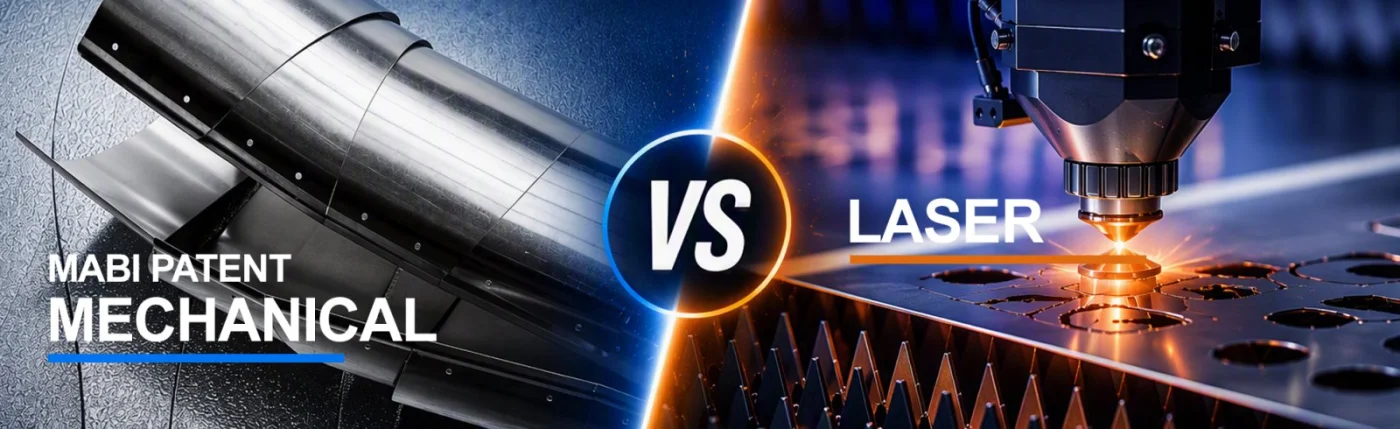
+ Pro Mechanical Cutting Systems
- Low operating costs
- Long service life of the cutting blades
- Easy maintenance and repair
- Suitable for many materials
- Proven and robust technology
- No thermal impact on the material
- At least a 10-year spare parts warranty
(MABI manufactures the cutting units in-house)
+ Pro Laser
- High cutting precision
- Non-contact cutting
- High flexibility for complex contours
- Clean cut edges
- Minimal post-processing

- Cons Mechanical Cutting Systems
- Tool wear
(depending on usage and material being cut) - Limited capabilities with complex geometries
- Cut quality depends on the condition of the tool
- Cons Laser
- High operating and maintenance costs
- Thermal effects (heat-affected zone) possible
- Not all materials can be cut equally well
(physical properties of the metal, such as thermal conductivity and absorption) - High energy consumption (especially when cutting holes)
- Film-coated sheet metal requires an expensive special film; otherwise, bubbles will form
- Increased requirements for occupational safety and laser safety
- Laser source from a third-party supplier (dependency)
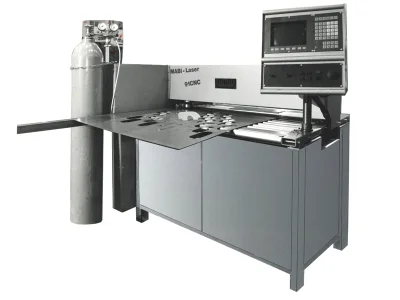
MABI’s First Laser (1992)
As early as 1992, MABI unveiled its first laser cutting system at the Blech trade show in Essen.
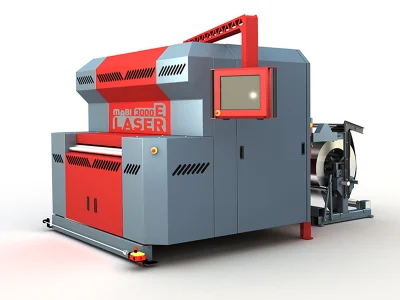
MABI 3000E EVO Laser (2015)
A number of MABI 3000E EVO Laser machines were sold. However, it became apparent that customers who had purchased a MABI laser later switched to mechanical systems.
More information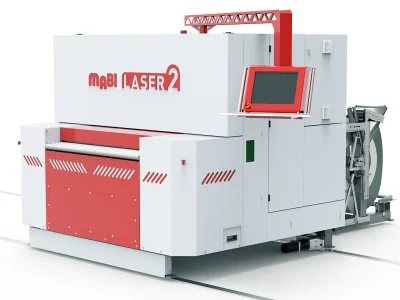
MABI Laser 2 (2026)
The latest development will be unveiled shortly. Suitable for duct fabricators and companies with specific requirements in the field of stainless steel.
More information"For 98% of insulation companies, mechanical cutting systems are the ideal solution—cost-effective and perfectly tailored to their needs."
Mechanical cutting systems
MABI manufactured the first cutting machines more than fifty years ago. Mechanical cutting has a number of environmental and investment advantages over laser cutting. There are no CO₂ emissions, no smoke and no fine dust for which you have to take precautions. Mechanical cutting also requires less energy than laser cutting. And there is another advantage: Aluminium offcuts can be offered to the metal trade as new material in the same way as stainless steel blades and punches at the end of their service life. These characteristics fit in perfectly with the principles of green technology.
Environmentally friendly plants and production are becoming increasingly important in light of the climate debate. More and more financial institutions such as banks are choosing to stimulate green technologies with favourable interest rates. Governments are increasingly rewarding environmental investments with tax benefits. This is a trend that will still gain more importance in the climate debate. The mechanical cutting machines from MABI are available in a so-called green technology version. Huge saving opportunities have been developed in the area of energy consumption and limiting cutting losses. Especially when several machines are used simultaneously in large companies, this can result in significant savings.

Our Experience with Laser Technology
- Maintenance is costly and time-consuming
- The insulation industry requires a wide variety of sheet metals (aluminum, zinc, aluzinc; chrome steel, Platal)
- Laser technology struggles with coated sheet metal or protective films
- None of our customers cut Platal with a laser
- Film-coated sheet metal requires an expensive special film; otherwise, bubbles form
- A laser cutting head should always be kept in the customer’s inventory (cost: approximately 4,500 euros = dead capital)
- Long lead times for replacement parts from third-party suppliers
- Cutting chrome steel produces toxic gases
- Strict occupational safety inspections
- You need an in-house laser safety officer
- Liability in the event of an accident
- When cutting with compressed air: A compressor, including a refrigerated dryer, with a flow rate of at least 650 l/min, an outlet pressure of at least 10 bar, and a storage tank of at least 250 l must be available. The hose running from the compressor to the machine must be at least ½ inch in diameter. The compressed air must comply with compressed air quality class 1.4.1 according to ISO 8573-1:2010, or better.
- The air connection must be permanently piped and located as close as possible to the machine’s installation site.
- The cost of a suitable (oil-free) compressor is approximately 10,000 euros.
- Significant electricity costs are incurred by the exhaust system, the filter system, and the laser itself.
Platal and film-coated sheet metal
Mechanical cutting systems:
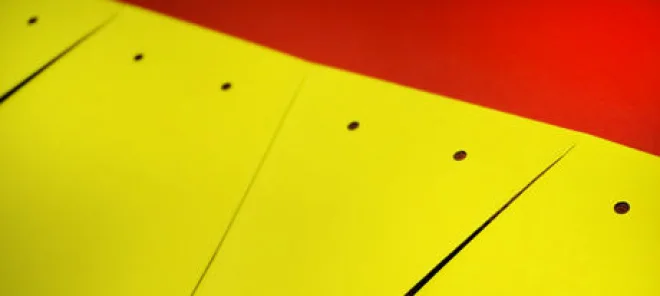
- Platal can be cut easily using mechanical cutting systems
- Film-coated sheet metal can be cut easily and, unlike laser cutting, without the need for expensive specialty film
- No toxic emissions, unlike laser cutting
- Holes are punched with precision
Laser:
- PVC (polyvinyl chloride) releases hydrogen chloride (HCl) during thermal decomposition or combustion
- HCl can combine with moisture in the air to form a highly corrosive solution (hydrochloric acid)
- These corrosive substances can:
- Damage the cutting head and protective glass
- Corrode metal parts, guides, and bearings
- Significantly shorten the machine’s service life
- Damage the exhaust system
- Laser cutting PVC produces gases that are harmful to health, in particular:
- Hydrogen chloride (HCl)
- Chlorine-containing organic decomposition products
- Smoke and fine dust
- A high-performance extraction system is absolutely essential
- Film-coated sheet metal requires an expensive special film; otherwise, bubbles will form
Virtually all manufacturers of CO₂ and fiber lasers expressly recommend against laser cutting PVC and other chlorinated plastics because:
- Corrosive HCl fumes are produced
- Machine components may be damaged
- The exhaust system is subjected to heavy strain
- Significant occupational safety requirements apply